Saturday, 23 March 2013

10 things I wish I knew about academia sooner...

In the second year of my undergrad degree I decided I wanted to go on into a career in higher education and research.  The only problem was I didn't really know much about how to make that happen, beyond that the next step was to get a Masters degree.  After that you did a PhD, and then after that a career magicked itself up and you were hired on as a junior lecturer and a successful career of teaching and research followed.  Right?

I remember coming to London to study for my Masters in palaeoanthropology and palaeolithic archaeology at UCL in 2008/9.  I had minored in archaeology, but still felt like a linguist crashing an archaeology club.  But I really wanted to do well, even though I barely knew what a dissertation was, beyond an extra long essay.  Most of the people on my course had done a dissertation for their undergraduate degree, so I really felt inexperienced in an alien discipline.  

Four years later, I feel I know a lot more about getting into an academic career, and the long and unstable path leading to job security and a regular paycheck.  So even though I was naieve, and I can't imagine I was alone in feeling a bit ignorant about things, it worked out ok.  

I do think though, that I could have benefited from a bit more support offered at undergraduate and Masters level when it comes to what actually goes in to building an academic career, and how best to make yourself the best candidate for acheiving that next step.  For instance, maybe I would have geared my dissertation to be a bit more empirically focussed - I feel I am at a disadvantage both for funding opportunities and later employability because I don't have any technical or analytical projects under my belt.  I've read lots of books and thought about them and that's about it...

Maybe if there was some sort of undergraduate or even graduate level module or lecture series that covered these sorts of topics, where people wanting to pursue research as a career could learn a number of things.  For instance, 
  • what the common career stages in academia?
  • what are the ways you can build up your CV as a young academic?
  • how does a research project get started?
  • what features in a project make it attractive for funding?
  • what does a funding application look like? 
  • what goes into preparing a paper to submit to a journal?
  • how does the peer review process work?
  • how do you review a paper?
  • how do funding bodies work?
  • how is a conference organised?

I still don't know anything about a lot of these questions, but thankfully it's a lot more than I did four years ago.  I imagine I'll have a lot of opportunity during my PhD to learn all of this, but I still think it would have been helpful information earlier on to know about.  I'm not sure what difference it would have made, but perhaps it would make students a bit more savvy and make better informed decisions about preparing for their highly competative and slow to get off the ground career.

What about you?  What do you wish you had known a bit earlier on, or are wondering about now?

Tuesday, 19 March 2013

Hurrah, hurrah, it's a PhD!

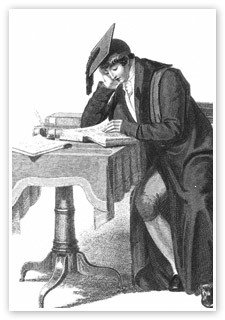
I'm even happier than this here guy!
I started this blog a few years ago to keep myself motivated and in the academic mindset, as I finished my Masters and anticipated a bit of struggle to get to the PhD stage.  It'll have taken 4 years, but I'm VERY happy to say I've been accepted to start a PhD at the University of Southampton!!!

I'm extremely pleased, as it's such a renowned university for Palaeolithic studies and there are so many amazing people that work, study, or have worked or studied there in the past.  I'll be very humbled to be among them!  And I don't know how, but somehow I've interested [b]Clive Gamble[/b] to be my supervisor!  Well I do know how, he has done amazing work and research that has influenced me and my ideas for years, and my project is related to his interests... but what luck!  Well, not luck... just amazingness!  And a bit of timeliness?  The Lucy to Language project has wrapped up and some of that work I'll be drawing on for my own project.

My own project... I've kept my project ideas a bit mum on this page, as at first they were changing so quickly, and then once I got really excited about them I didn't want to do something such as !!post them!! - and see them crumble!  But I'm really excited about the project I put forth, and while there are weaknesses, I think the support I'm likely to get at Southampton and the absolute MOST I'm going to give this, will hopefully produce something really valuable to both Palaeolithic archaeology and language evolution disciplines, and take me on the next step in an eventual career path!

I haven't heard about funding just yet, but I'm crossing my fingers in hope.  I'll be commuting from Oxford, and funding will mean I can spend more time at the department... and eat more!  Without funding I can barely make it work, with a bit of part time work here and there along with my jewellery business, but I've been wanting to do this for so long that I'm just happy to jump in however many nights of rice and beans I have to go through.

I'll post soon about my project idea as it is, and then run and hide... it scares me because I like it!!

Tuesday, 12 March 2013

Why does human cultural achievement mean Neanderthal demise?

Again and again, science news publish articles headlining things such as "Humans were genius sexy amazeballs, Neanderthals died of jealousy", or, "Humans wore shoes, Neanderthal extinction due to Osteoarthritis?"

Alright those are fake, but they aren't that much of an exaggeration.

This could have been the very skill that allowed humans
to bound across the European landscape,
ejecting Neanderthals from their cave...
Such as this article in Scientific American entitled "Oldest Arrowheads Hint at How Modern Humans Overtook Neandertals", or this article from National Geographic Daily News published yesterday, "Failure to Hunt Rabbits Part of Neanderthals' Demise?"

The first article I point to is a good example of why I'm not quite following the logic - it is about early projectiles from South Africa, a continent away from any possible human-Neanderthal interaction/competition.  These projectiles would have been a nice fancy cultural innovation for hunting strategy.  And Neanderthals just couldn't cope with their inferior spears... extinction naturally followed.

Sorry, what exactly did the impact of these tools have?  Underlying these articles is just an implicit assumption that life is a boxing ring, and the fighter with the fancier shorts wins (ie doesn't extinct themselves).

Any cultural detail different between our two species seems to be taken immediately to be a marker of why one is here today and the other isn't.  Because, for some reason I can't quite figure out, humans being better at life eradicates other life around it.

But species go extinct all the time.  Why does this one deserve so much attention?  At least that question is easier to understand - our obsession with the demise of the Neanderthals is fascinating, and that fascination leads to endless "what ifs" and fanciful speculations based on little or no evidence.  Neanderthals are us but not us, close cousins that resemble human groups in some ways, but not in others.  They are fascinating.  They are so similar, but they failed.  And we see our differences, our Nectar Points and jet packs, as the reason we have won... something.  Life I guess.  Although, we don't go on about our triumph over the Australopithecines (Husband, pers. comm.)

It's a fascination with different cultural groups that led 19th century anthropologists to come to so many conclusions as to why the 'savage races' were inferior to their own amazing mustachioed culture.

Modern humans have undoubtedly impacted most (all?) species on the planet alive today.  And we seem to extend this impact right back into the Palaeolithic - I can't say whether or not there is a grain of truth in that, and that we did make an impact on our landscapes, but we do have to look at our own species, small in number, without Nectar points or jet packs back then, and maybe have a bit more humility.

Sunday, 24 February 2013

Survivorwoman

Les Stroud for Prime Minister of Canada!
I am a huge fan of Les Stroud, of Survivorman fame.  Not only is he Canadian and full of integrity, he can play some mean harmonica while teaching viewers about survival skills in different ecosystems, from different camera shots he patiently positions and films without a video crew.

There's the awesome Ray Mears and the *ahem* so-so Bear Grylls as well - plus a few others who have achieved less celebrity status.  Like that guy on the Channel 4 series that cried about not wanting to kill a porcupine.

But all of these survival heroes are men, and I'd love to have a female survivalist to idolize - I'm not aware of any women who star in their own survival show though. I've done no research, but I bet most survivalist companies in Britain are led and taught by men as well.

When I realised this, it set me thinking - I'd LOVE to be 'Survivorwoman'!

A female take on wilderness skills would be fascinating.  Women and men are different creatures,  biologically and sociologically - and the result of watching a lone woman surviving and teaching an audience through the camera would be a new viewing experience.  Plus, I want to do it.

I could totes make one of these, man
from woodland-ways.co.uk
Now I'm not in any way an expert on wild food, bushcraft, or primitive skills.  I also have no presenting skills, and possibly no aptitude for it, though I used to be an English teacher and have no fear of the spotlight, and indeed often can't be stopped speaking.  I'm enthusiastic and curious, and determined - I don't mind being made a fool of either!  I grew up in the woods, and USED to know the trees and animal species and which berries to eat and not eat from the land, until I moved to bigger and bigger towns and finally changed country, where my knowledge of the natural landscape I live in is liteally now, quite foreign.

There's thousands of people in the UK that probably would have a much better CV suited for the star Survivorwoman casting role.  I'm small and weak, and probably can't swim (I'm not sure, I have a fear of water and generally try to avoid testing an old skill!  Is it like riding a bike?), and haven't even camped much since childhood.  I struggle to light fireplaces.  I've tried stone knapping, I put a hole in my jeans and got a blood blister.

BUT!  That means I'm someone who needs to learn, right?  And what better way for viewers to learn then watching another person repeatedly fail to light a fire?  Identify plants and trees?  Make a shelter in the woods?

So if you know anyone in a production company, please tell them my pitch and give them my name and details.  I'd love to go without a shower for seven days and sleep on the cold rocky ground with the bugs.  I'm an archaeologist after all.

Saturday, 23 February 2013

Genetics and the Last Human Common Ancestor

I thought I was on to something yesterday, but it actually just highlighted the fact I need to learn a bit more (a lot more) about human genetics.  It involved a lot of rough sketching of human phylogenies, and confused questions to my husband.  I think sadly, the breakthrough I was working towards is not actually anything really interesting.

I was thinking about supporters of macromutations for the origin of grammatical language (as I do).  Many of these theories also posit a late emergence of language, between 50,000 and 100,000 years ago (it's become quite normal to talk of some kind of 'consensus' that language evolved roughly 100,000 years ago - I'm sorry, did I miss that meeting?).  Some examples would be research by Norbert Hornstein, old work by Davidson and Noble, and basically anyone with a conservative view of language emergence who is smart enough to drop the 'human revolution' ideas of the 80s and 90s.  I'm guessing this date is reached because of accepted material culture proxies seen in the archaeological record taken as undoubtably 'symbolic' - 90,000 year old beads at Qafzeh cave and the like, and the dating of Out of Africa 2.
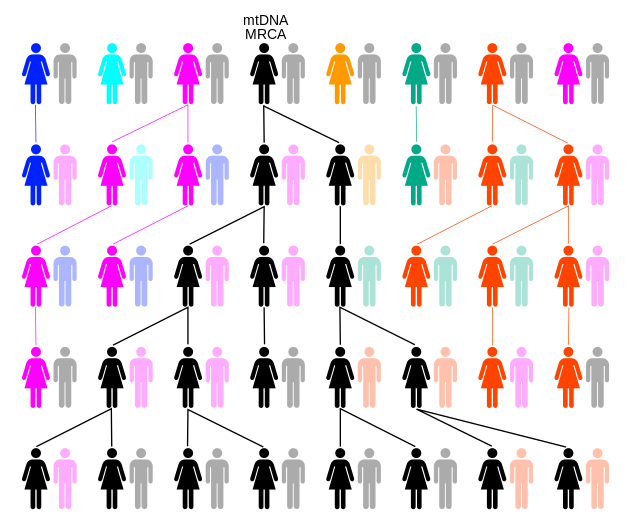
"Through random drift or selection lineage will
trace back to a single person. In this example
 over 5 generations, the colors represent extinct
 matrilineal lines and black the matrilineal line
 descended from the MRCA." - Wikipedia

My thought process went like this.  If humans require a robust neural substrate in order to be linguistic beings, this substrate must have evolved before the last common human ancestor, otherwise a portion of humans living today would not have this genetic endowment for language.  And since all human populations are language capable, this 'macromutation' or whatever is being proposed, is very old indeed.

Or so I thought.  mtDNA allows us to trace back our last maternal ancestor, our 'mitochondrial eve', and this human lived around 200,000 years ago.  Y-chromosone DNA can also be traced back to a last common ancestor, which if I'm remembering correctly dates to around 50,000 years ago.  Our ancestral... Adam we could say.  But for the sake of this argument, I wanted to know how long ago the most recent person that was ancestral to all living humans lived.  So I did some internet trawling and ended up with a big surprise.

The date of the most recent common ancestor is a limit on the minimum recency a genetic macromutation for language could have feasibly spread to all modern humans.  And I was expecting this date to resemble the date for mitochondrial eve, or at least farther back than the conservative estimate for the evolution of human language (though if I was thinking about the Y-chromosone dates I would have realised it wasn't going to be earlier than that).  But, dating back a single gene will necessarily go back further than the most recent common ancestor, which turns out to be a much more recent date that all humans can trace back to (Wikipedia):

The identical ancestors point for Homo sapiens has been estimated to between 15,000 and 5,000 years ago.[4] 

Woah, really?  I wasn't expecting a date that recent for a common human ancestor between all humans living today (You can click on the Wikipedia citation in the quote for a link to a Nature article on this subject).

So, my idea about the dating of the last common ancestor of humans doesn't force back the limit on macromutationist accounts of a recent origin of human language like I thought it might.  But it was an interesting exercise.

So you're safe for now, macromutationists.  But you're still biologically unlikely.

Monday, 18 February 2013

Catch-up: France and Flint


Last summer I decided to pull up my socks and be a REAL archaeologist.  No more of this ‘watching time team and casually reading about Anglo Saxons’ stuff (which probably wont stop, but anyways)!  I volunteered for the Les Cottes dig in France directed by Marie Soressi, and for a month from half July to half August, I spent an amazing time crouched over on a meter square of dirt developing my right bicep.

It was a fantastic dig – giant cave, giant pit, giant piles of finds – and I felt like I learned so much, this being only my second excavation.  I will definitely try to go again.  The flint in France is gorgeous (pretty translucent ochre colour flint banded with red, and some a lovely raspberry, or deep violets that were almost black) – the area of Poitou we were in is renowned (by flint enthusiasts anyway) for the quality and abundance of material, and the area is rich with prehistoric cultures going back deep into the Palaeolithic. 

Les Cottes itself was first excavated in the 1800s, and again in the 50s.  This excavation led by Marie Soressi took place out in front of the mouth of the cave, in in-situ deposits that held amazingly rich layers of not only classic Aurignacian materials, but Proto-Aurignacian, Chatelperronean and Mousterian as well!  There were vertical walls where you could see the layers, full of flints and antler sticking out, and some layers were red with ochre or black with manganese.  A European Palaeolithic archaeologists’ dream!

Nodular flint we dug up from fields nearby
There were also opportunities while we were there to collect some nearby flint and try our hand at knapping.  I’ve tried knapping obsidian before, and this was my first time trying with flint.  I’ve realised I am a terrible knapper, and although I love lithic technology and the look and feel of flint and the amazing things it can do, I am going to need 5x as much tuition as the next person to be a competent flint knapper.  Lesson one: not putting a hole in the thigh of my trousers.

I met some amazing people on the dig and hope to keep in touch with many of them.  Most of all it’s made me fall in love with flint – although British flint is interesting, I find it a bit more cold and masculine – icy black Norfolk flint, or the steely grey of the south, or the dull orange patina some old flints get here – it’s definitely not as sexy as the French flint!!!

Here's a link to the description of Les Cottes on the Max Planck Institute website:
http://www.eva.mpg.de/evolution/files/les-cottes.htm

And here's a paper on Les Cottes if you are interested:
http://www.sciencedirect.com/science/article/pii/S0305440311003463

Thursday, 14 February 2013

European Palaeolithic Conference: 21-23 February

For a closer conference (temporally and geographically), the European Palaeolithic Conference will be held at the British Museum.  It includes free entry into the current exhibition on Ice Age Art which should be good.

http://www.ahobproject.org/announcements.php

Here is a program as well, to see if anything tickles your fancy:

http://ahobproject.org/downloads/European%20Palaeolithic%20Conference%20programme.pdf


Wednesday, 13 February 2013

Evolang 10 in Vienna, Austria - and reflections on the last Evolang

Kyoto
February of last year was the 9th biannual conference on the evolution of language – known affectionately as Evolang (http://kyoto.evolang.org/).  I had done some major saving and scraping to get together enough funds to go (especially since I had just had a wedding four months previously!), and dragged my new husband along with me too, promising that the evolution of language offers archaeologists PLENTY of interesting talks and networking opportunities.

I’ve been to Kyoto before, in 2006 when I went on a lone backpacking trip across Japan.  I absolutely loved the country and was so excited to return and utilise my rusty Japanese (for which I had brushed up on by taking an evening course after work twice a week, and submerged myself in language lesson podcasts!  (http://www.japanesepod101.com/).

Vienna
It was my third time attending an Evolang conference, and my first time actually presenting.  I had two posters – one written with Luke McCrohan called Sea Crossings are an Unreliable Indicator of Language Ability in Hominids.  The second I piece I presented, and on an idea I had been slowly nurturing called The First Word Was Not a Noun.  It’s a subject I would ideally like to come back to and develop - I'm just not sure how.  What I do know is that the origins of syntax remains my most curious topic in language evolution…

So my husband and I spent 6 nights 7 days in Japan, and ended up having an amazing time.  Though we never quite recovered from the jet lag, we met up with some amazing people I’ve met at past conferences, and made new friends as well.  The conference itself was fantastic, and had some great talks by geneticist Simon Fisher, biolinguist Massimo Piatelli-Palmarini, and of course the incredible Simon Kirby. Palaeolithic archaeology in general was a bit lacking (understatement!), save for a few mentions of Neanderthals here and there (many thanks to Sverker Johansson).  Unfortunately the lack of archaeology, paired with copious amounts of talks on Zebra Finches, made the conference a bit boring for my archaeologist non-linguist husband.

As the conference was now a year ago I don’t trust myself to go too in depth on any of the topics heard (in fact I’m just too lazy to retrieve my notes), but I'll try to be good when the next one rolls around - which will be in 2014 in Vienna!

http://evolangx.univie.ac.at/

Plenary speakers will include:

I hope to see you there!

Sunday, 10 February 2013

Ice Age Art: A Culture Show Special

The Culture Show recently released a special episode on the new exhibition at the British Museum about Ice Age Art.  Andrew Graham-Dixon took us to a number of cave sites in Spain and France, and took a look at many of the items that will be at the exhibition, discussing cave art and prehistoric European portable art with notable people such as archaeologist Steve Mithen and anthropologist Camila Power.  It was an enjoyable look at pieces I hadn't seen before, especially more recent pieces from the end of the ice age.

My favourite guest was an experimental archaeologist from Germany - to be honest the whole programme could have focussed on him and the work he does because it was facinating!  It showed his mammoth ivory carvings made to be replicas of prehistoric pieces, fashioned with flint blades that must have taken so much more patience than I have when I'm sitting at a table with my malleable polymer clay which just pops into the oven for 10 minutes to be finished.


I enjoyed a class during my undergraduate degree at Simon Fraser in Canada, where archaeologist Brian Hayden led us in a number of experimental archaeology exercises.  In one, we all came to class with a shell - and out back in the sandbox/knapping pit, we went to work with clumsy obsidian tools to fashion a bead, including piercing a hole.  It took hours - and I cheated a bit by grinding my shell against the concrete side of the building.  My bead is still around somewhere as I used to carry it around in my purse, along with a little bone fish I also made in that class.  Good class!

In the programme, the host also spoke with art historians and artist Antony Gormley.  It was nice to have contributions from modern artists and people in the art world, but I think it might have lended some confusing speculation to the conversation.  Modern western art is its own beast, and while it may well have been similar in the past, we don't have any way of saying it was and I would have liked to see a bit more impartiality rather than the expected speculations about the prehistoric artists' motivations and intentions.

But still, speculation makes good and entertaining television, and I'm sure this programme will bring a lot of people to the BM and generate a lot of talk about art in the Upper Palaeolithic in Europe.  And anything promoting the Palaeolithic is good in my books - far too often I think people can forget that there is a past far beyond the Romans and Egyptians, illustrated by the bewildered looks and expresions of amazement from Graham-Dixon as he spoke about 'deep history'.

Which brings me to another problem I had with the programme - a few times he mentioned how these cave artists were all of our ancestors.  I don't mean to be pendantic, but they weren't.  They might be the ancestors of no one living today at all as well!  Without genetic evidence we can't be sure that these early European modern humans didn't die out and leave no genetic signature in modern populations today in modern Europeans.  And I resented how by 'everybody' he meant Europeans - which is a bit exclusionist.

But again, prehistoric publicity of any sort is good publicity and this exhibition looks to be one that shouldn't be missed!  It's running between now and late May, so get your tickets and enjoy if you can get to London!

Did you see the show?  What did you think?

Here's a link to the programme on BBC 2 (only available in the UK I presume!)

http://www.bbc.co.uk/iplayer/episode/b01qrmpz/The_Culture_Show_Ice_Age_Art_A_Culture_Show_Special/

Saturday, 9 February 2013

Blog reopening - watch this space!

After over a year and a half, (I see my last post was 2011...?) I've decided I'm going to start this blog up again.  I feel bad I let it trail off, but it illustrates how I found it difficult to keep motivated in my academic studies when my life was just so focussed on other things.  I would have loved to have launched right into a PhD back then, and keep this blog going as a journal/sketch pad of my thoughts and ideas, but things didn't quite turn out that way!

So why am I back now?  I've applied for a PhD to begin next Fall.  I have a potential project, a potential supervisor, and I'm really positive about the whole thing.

"Hooray!" say Cory's readers
What changed?  Well, after having lived in the UK now for over three years as a non-student, I'm now considered a 'home' student and am elligible to pay the regular tuition rate instead of the overseas rate.  I've also been working and saving in the meantime, and I'm going to try the self funded route (although fingers, toes, eyes, everything is crossed that I might be lucky enough to receive funding or partial funding!)

So with that I really need to get myself back into a headspace I was three years ago, fresh out of a Masters and somewhat up to date with the research.  I haven't been completely out of the loop - I've attended conferences, presented a poster here and there and even submitted a full paper to the last Evolang conference in Kyoto with a colleague.  I went digging in France in the summer, and now feel less of a 'fake archaeologist'.

Hopefully, then, this marks a step towards that academic career I've been striving for - watch and see if it is!

~Cory


Related Posts Plugin for WordPress, Blogger...